
Why Agentic AI Coding Stalls in the Enterprise (And It's Almost Never the Model)
Agentic coding pilots rarely stall because of the model. They stall on missing specs, undocumented knowledge, and weak governance — and that layer is fixable.

Most engineering leaders now have an agentic-coding story that follows the same arc. A pilot lands with a small team, the early demos are genuinely impressive, and leadership greenlights a wider rollout. Then the rollout stalls. Velocity doesn't climb the way the pilot promised, senior engineers quietly stop using the agents, and the post-mortem lands on a familiar verdict: the AI just isn't good enough yet.
Key Takeaways
- Agentic coding rollouts rarely stall on model quality — they stall on the knowledge layer underneath: specifications, organizational knowledge, and governance.
- Agents amplify ambiguity instead of surfacing it. A vague ticket that a senior engineer silently completes becomes a confident, plausible, wrong diff at machine speed.
- Most teams have never had to write down their conventions and boundaries, so agents are often the first "team member" to expose how much was undocumented.
- Governance means three concrete answers: what agents may touch, how output is reviewed, and whether you can reconstruct what happened.
- The foundation is fixable on your own timeline. The model's roadmap is not.
The failure everyone blames on the model
It's a comfortable conclusion because it puts the problem outside the building — a vendor problem, a wait-for-the-next-model problem. It's also, in most cases, wrong.
The models are rarely the weakest link. The failure sits one layer down, in the part of your engineering organization that never had to be written down before: your specifications, your captured knowledge, and your governance. Get that layer wrong and a better model just produces wrong work faster.
When an agentic workflow underperforms, the visible symptom is always the output — a bad diff, a subtle regression, a pull request that technically satisfies the ticket while missing the point entirely. It's natural to trace that back to the thing that generated it.
But look at what a coding agent actually consumes: a ticket, a codebase, whatever context you hand it, and an implicit set of rules about what "done" and "allowed" mean. In a strong human team, most of that last category is never spoken aloud. A senior engineer reads a thin ticket and silently fills in the missing 80% — the edge cases the PM didn't mention, the service you don't touch without review, the migration pattern the team standardized on two years ago. That silent completion is the organizational knowledge, and it's exactly what an agent doesn't have.
This is the argument Pavel Spesivtsev makes on Engineering Choices You Have to Defend, drawing on roughly eighteen months of implementing agentic development workflows across organizations. His pattern is consistent: the models are seldom what breaks. Failures emerge from incomplete specifications, missing organizational knowledge, and weak governance — long before the model is the bottleneck.
Independent research points the same direction. RAND's 2024 report The Root Causes of Failure for Artificial Intelligence Projects — based on interviews with 65 data scientists and engineers — identifies five root causes of AI project failure. Four of the five are organizational rather than technical: misunderstanding the problem, lacking the data to train on, chasing the newest technology instead of a real user problem, and inadequate infrastructure to manage data and deploy models. Only the fifth is a genuine capability limit. Agentic coding moves that same lesson upstream into your own codebase.
What "knowledge infrastructure" actually means
"Knowledge infrastructure" sounds abstract until you break it into the three load-bearing layers underneath any agentic workflow:
- Specifications — the machine-readable statement of what a change should do, what "correct" looks like, and what's explicitly out of scope. Not a two-line Jira ticket.
- Organizational knowledge — the conventions, patterns, service boundaries, and hard-won "don't do that" rules that currently live only in senior engineers' heads and in Slack history.
- Governance — the rules and checkpoints that decide what agents are allowed to touch, how their output is reviewed, and how you keep an auditable trail of what happened.
Humans quietly supply all three from context. Agents need them made explicit. The uncomfortable truth is that most teams have never had to externalize this layer, so a coding agent is often the first "team member" that exposes just how much of your engineering practice was undocumented all along.
If your architecture itself is ambiguous — unclear boundaries, implicit contracts, tribal ownership — that ambiguity surfaces immediately once agents start working across it. This is why an honest software architecture and software audit pass is usually a prerequisite for agentic coding, not a nice-to-have after it.
Why incomplete specifications break agents first
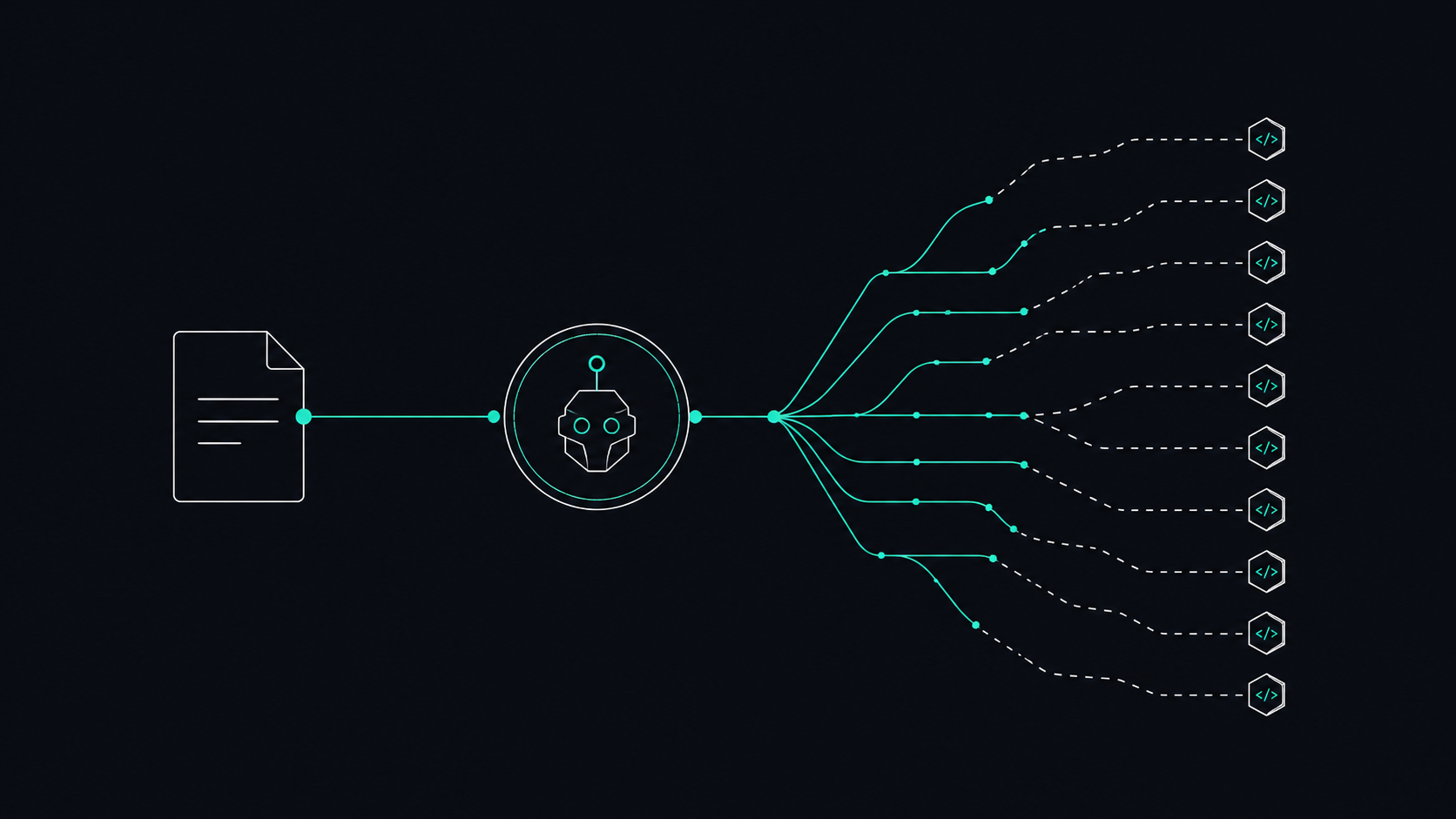
Agents amplify whatever ambiguity you feed them. A vague ticket handed to five human engineers produces five reasonable, roughly convergent interpretations, because they share context. The same vague ticket handed to an agent produces a confident, plausible, and possibly wrong interpretation — at machine speed, and often at machine volume.
That's the failure mode teams underestimate. The agent doesn't stall on ambiguity the way a junior engineer does by asking a clarifying question. It fills the gap and keeps moving. Multiply that across dozens of tickets a week and you don't get a productivity gain; you get a review backlog, because every diff now needs a human to reverse-engineer whether the agent guessed your intent correctly.
The data backs this up. In Stack Overflow's 2025 Developer Survey, 84% of respondents use or plan to use AI tools — but only 3.1% say they highly trust the accuracy of what comes back, and more developers actively distrust it (46%) than trust it (33%). The single biggest frustration, cited by 66%, is AI solutions that are "almost right, but not quite" — precisely the failure mode that vague specifications produce, and precisely the one that burns the most time to debug.
The fix isn't a better prompt. It's treating specifications as a real engineering artifact: acceptance criteria that are testable, scope boundaries that are explicit, and the relevant conventions attached to the work rather than assumed. Teams that get real leverage from AI-enhanced development invest in the spec layer first — because a precise specification is the single highest-leverage input an agent receives.
The governance layer: guardrails, review, and traceability

Even with clean specs, scaling agents across teams without governance is how a promising pilot becomes a liability. Governance for agentic coding comes down to three questions with concrete answers:
- What may the agent touch? Define the blast radius. Some services, migrations, and security-sensitive paths should be off-limits or require explicit human initiation — not because the agent is reckless, but because the cost of a confident mistake there is high.
- How is output reviewed? Agent-generated code needs a review path that's at least as rigorous as human code, and usually more so, because the failure modes are different — plausible-but-wrong is harder to catch than obviously-broken.
- Can you reconstruct what happened? Traceability — which agent, which prompt, which spec, which reviewer — matters everywhere, and it's non-negotiable in regulated and security-sensitive contexts where "an AI wrote it" is not an acceptable answer to an auditor.
None of this is exotic. It's the same discipline mature teams already apply to CI, code review, and change management — extended to a new kind of contributor. The organizations that skip it aren't moving faster; they're accumulating a category of risk they can't yet see.
A readiness checklist before you scale agentic coding
Before you widen an agentic rollout beyond a pilot team, get honest answers to these:
- Specs — Can a competent stranger implement a typical ticket correctly from the ticket alone? If not, your agents can't either.
- Conventions — Are your standards, patterns, and service boundaries written down and attached to the work, or do they live only in senior engineers' heads?
- Blast radius — Have you explicitly defined what agents may and may not touch?
- Review capacity — Do you have a review path that can keep up with agent output without becoming the new bottleneck?
- Traceability — Can you reconstruct how any given change was produced and approved?
- Architecture clarity — Are your boundaries and contracts clear enough that work across them doesn't require tribal knowledge to get right?
If most of those answers are "no," the honest conclusion is that you don't have a model problem — you have a foundation problem. And the good news is that the foundation is fixable, which the model's roadmap is not.
Getting the foundation right
Agentic coding is one of the highest-leverage shifts in software delivery in a decade, and the teams that win with it won't be the ones with the best model access — everyone will have that. They'll be the ones who did the unglamorous work of making their specifications precise, their organizational knowledge explicit, and their governance real before they scaled.
That work — architecture clarity, an honest software audit, optimization of the delivery pipeline, and the AI engineering practices that sit on top — is exactly what we do at Code Particle. If your agentic pilot looked great and your rollout stalled, the model probably isn't the thing to fix. Let's talk about the layer underneath it.
This article draws on Pavel Spesivtsev's conversation on Engineering Choices You Have to Defend, hosted by Code Particle's Nicola Onassis.